9min
9min

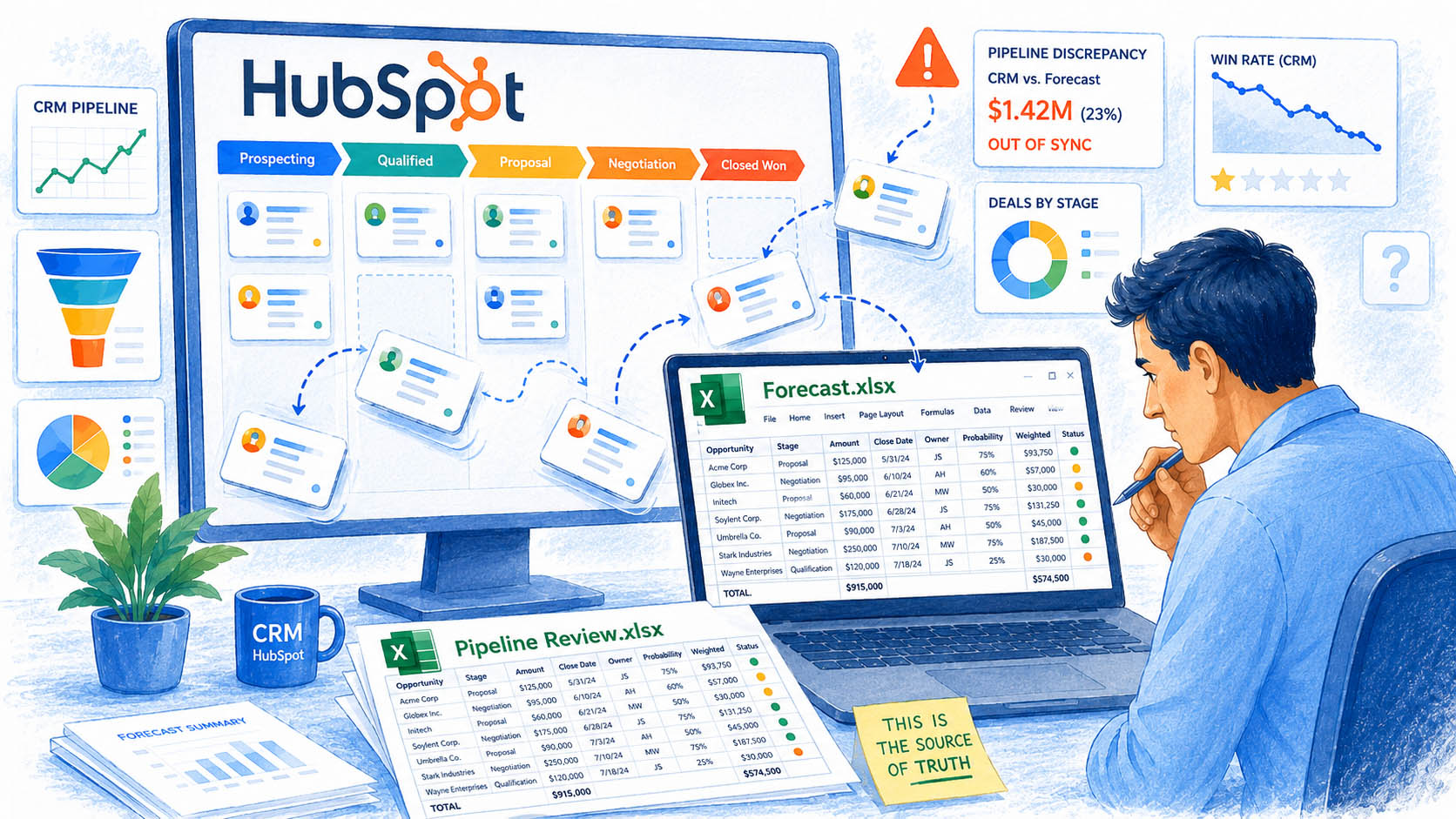
Someone opens HubSpot before the weekly pipeline meeting, exports the deals into a spreadsheet and starts preparing the version that managers will actually use. Columns are rearranged, comments are added, probabilities are adjusted and rows are highlighted to show which opportunities need attention. By the time the meeting begins, the spreadsheet has become the working view of the pipeline and HubSpot has been reduced to the place the data came from.
There is nothing inherently wrong with exporting CRM data. Spreadsheets remain useful for analysis, modelling and one-off exercises. The warning sign is when the real pipeline conversation cannot happen confidently without the export. At that point, HubSpot is no longer functioning as the live management system. It is supplying information to a separate process where the real judgements, challenges and decisions take place.
That distinction matters because pipeline reviews are not simply reporting meetings. They are where commercial leaders test whether opportunities are real, whether the forecast can be trusted and where management attention is needed. When that work happens outside HubSpot, the business begins to lose the connection between the decisions managers make and the system the sales team is expected to use.
What a spreadsheet-led pipeline review usually looks like
The process often begins for sensible reasons. A sales leader wants a cleaner view of the pipeline, RevOps wants to remove irrelevant fields, or a manager needs space for notes that do not appear in the standard HubSpot report. The export is quicker than redesigning the system, so it becomes part of the weekly routine.
Over time, the spreadsheet gathers more responsibility. Managers add their own comments, create informal risk categories, change forecast probabilities and record actions beside individual deals. One person may own the master version while others circulate copies with their own changes. HubSpot is updated later, usually by the salesperson, assuming the decisions made in the meeting are transferred back accurately.
This creates a split operating model. HubSpot contains the official records, but the spreadsheet contains the management interpretation of those records. The two may look similar at the start of the meeting, but they begin to diverge as soon as somebody changes a forecast, challenges a close date or agrees a new action. The more important the meeting becomes, the more commercially significant that gap becomes.
The problem is not that leaders are using a spreadsheet. It is that the spreadsheet is doing work the CRM should already support. It is holding the context, judgement and decisions that make the pipeline useful to the business.
Why managers feel they need the export
Managers rarely create spreadsheet workarounds because they enjoy duplicating effort. They do it because the live HubSpot view does not give them enough confidence to run the meeting well. The pipeline may contain too many stale deals, stages may mean different things to different people, or the forecast categories may not reflect how leaders actually judge risk.
A spreadsheet gives the manager a sense of control. It allows them to remove noise, add context and shape the information around the questions they want to ask. It may also be the only place where they can see the manager's view of an opportunity alongside the salesperson's view. In the short term, that makes the meeting easier.
The difficulty is that the workaround relieves the symptom without correcting the operating problem beneath it. The manager becomes responsible for cleaning and interpreting the pipeline every week, while the rules inside HubSpot remain unchanged. Salespeople continue using stages inconsistently because the real standard exists in the manager's spreadsheet or in the conversation, not in the system.
This is why spreadsheet-led reviews can survive for years. They help capable people compensate for a CRM they do not fully trust, but they also reduce the pressure to fix the reason that trust is missing.
Request a Pipeline Drift Workshop >
Another dashboard will not solve the problem
The obvious response is often to build a better dashboard. That may improve visibility, but it will not necessarily remove the need for the spreadsheet. A dashboard can display the values held in HubSpot more clearly. It cannot decide whether those values reflect commercial reality.
For example, a dashboard can show that a deal is in Proposal Sent and expected to close this month. It cannot tell the leadership team whether the buyer has agreed the decision process, whether budget has been confirmed, whether the proposal has been reviewed or whether a clear next step exists. If the stage only proves that a salesperson sent a document, the dashboard is presenting activity rather than buyer commitment.
The same limitation applies to forecast probabilities. A report can calculate a weighted pipeline using the percentage assigned to each stage, but that calculation is only useful when the stages are consistently applied. If one manager treats Proposal Sent as a strong buying signal and another treats it as an early indication of interest, the numbers may look precise while the assumptions beneath them remain inconsistent.
Better reporting is valuable when the operating rules are already clear. Without those rules, it makes inconsistent data easier to see, not easier to trust.
The operating problem beneath the spreadsheet
A pipeline review can only happen effectively inside HubSpot when the business has agreed what the system is meant to represent. That starts with clear pipeline stages, but stage names alone are not enough. Each stage needs a shared evidence standard that explains what must be true before an opportunity moves forward.
The evidence should relate to the buyer, not simply to seller activity. A discovery call taking place does not automatically prove that the buyer has accepted the problem or agreed to a next step. A proposal being sent does not prove that the buying group has reviewed it, that the commercial case is accepted or that a decision date is credible. Managers need to know what buyer behaviour or commitment supports the stage, otherwise deal movement becomes a matter of individual judgement.
The business also needs clear rules for close dates, next steps, forecast categories and stalled opportunities. Managers should know what they are expected to inspect and what action follows when the evidence is weak. Salespeople should know which information must be current before the review begins. HubSpot should then be configured to support those expectations rather than forcing managers to recreate them outside the system.
Consider two managers reviewing similar opportunities. One keeps a deal in Proposal Sent because the proposal has been delivered and the prospect remains responsive. The other moves an equivalent deal backwards because no review meeting has been booked and the decision process is still unclear. Both decisions may sound reasonable, but the pipeline cannot support a consistent forecast if the standard changes with the manager.
The spreadsheet often hides this inconsistency because the most experienced person adjusts the numbers before they reach the wider leadership team. The forecast appears to have been corrected, but the underlying pipeline has not learned anything from the correction.
Request a Pipeline Drift Workshop >
What this does to forecast confidence
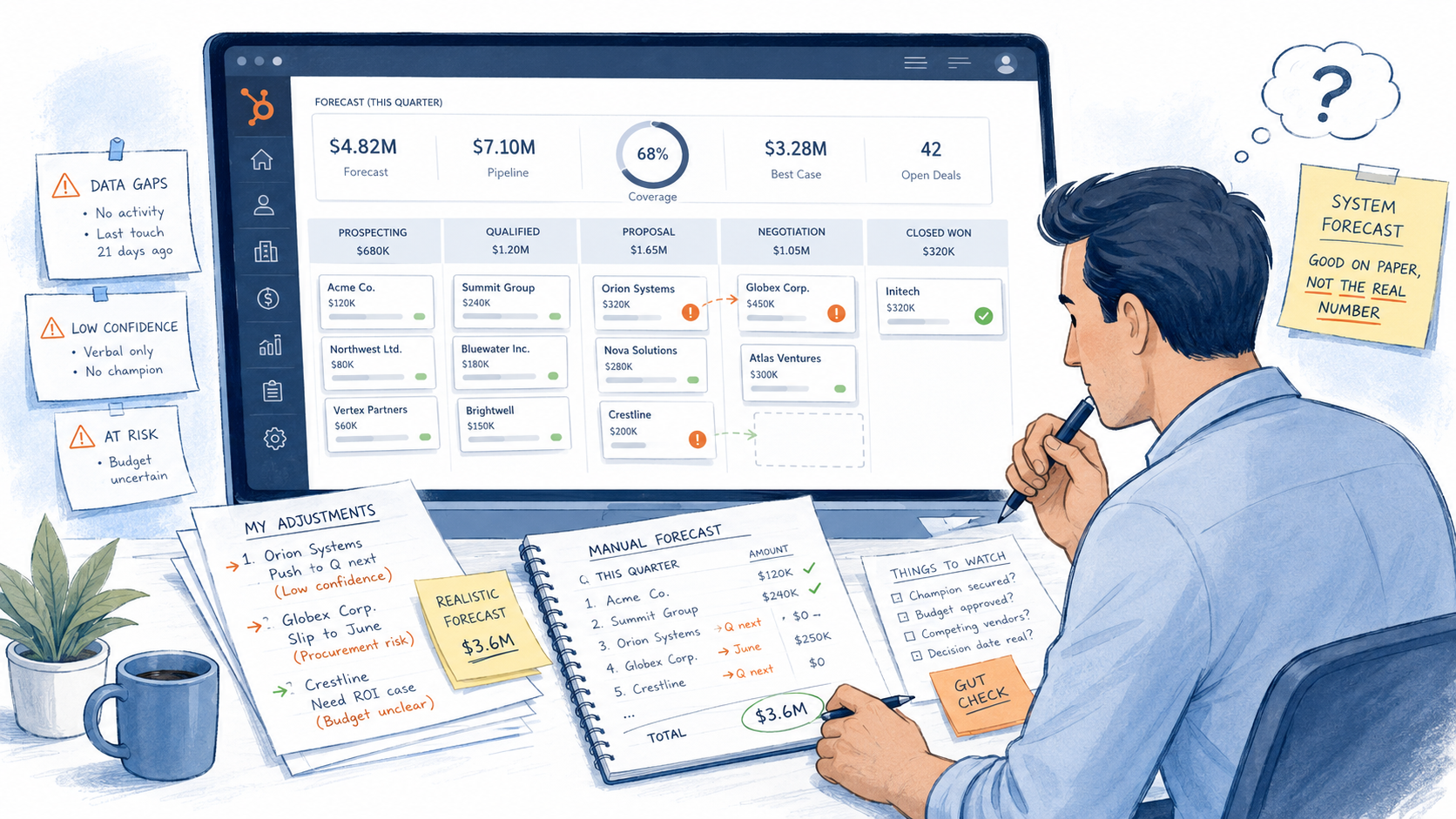
When the management process happens outside HubSpot, leadership receives a forecast that depends heavily on manual interpretation. The sales leader may know which deals are weak, which close dates are optimistic and which opportunities need to be discounted. That judgement can produce a plausible number, but the confidence sits with the individual rather than with the operating system.
This creates a recurring dependency. Every week, the pipeline has to be exported, cleaned and explained before senior leaders can use it. If the person who normally prepares the view is absent, the business may struggle to reproduce the same judgement. If another leader challenges the forecast, the evidence behind the number may be scattered across CRM notes, meeting comments and private spreadsheets.
The commercial consequence is not limited to reporting inconvenience. Forecast confidence affects hiring, delivery planning, cash decisions, marketing investment and the expectations set with boards or investors. Leaders do not need absolute certainty, but they do need a consistent view of what is known, what is assumed and where the risk sits.
A spreadsheet can help a skilled manager produce that view. It cannot provide the business with a repeatable management system unless the logic behind the spreadsheet is brought back into HubSpot and reinforced through the weekly review rhythm.
Five questions to test whether HubSpot is really your management system
A useful starting point is to look at how the next pipeline meeting will actually run. The following questions are more revealing than asking whether the team logs into HubSpot or whether the dashboards are technically accurate.
1. Could the meeting run effectively inside HubSpot if the export did not exist?
If the answer is no, identify what the spreadsheet provides that HubSpot does not. It may be better context, clearer risk categories, manager commentary or a more reliable forecast view. That missing element usually points towards an operating rule that has not yet been built into the system.
2. Are forecast decisions updated in HubSpot during the meeting?
When managers change a category, challenge a close date or agree that a deal should leave the forecast, the decision should be reflected in the live record. If updates are left for later, the system becomes out of date at the moment the meeting creates new information.
3. Can managers see the evidence behind every important stage?
A stage should help the manager understand what the buyer has done or agreed. When the evidence only exists in the salesperson's explanation, the pipeline is relying on memory and persuasion rather than a shared standard.
4. Would two managers reach a similar conclusion from the same deal record?
Perfect agreement is unrealistic, but the system should support broadly consistent judgement. Large differences usually mean stage rules, forecast definitions or qualification expectations are unclear.
5. Does the leadership team trust HubSpot more than the spreadsheet?
This is the central test. When leaders treat the spreadsheet as the corrected version of the pipeline, the CRM is not yet carrying enough operational authority to run the business.
What a better weekly pipeline meeting looks like
A management-led pipeline review begins with HubSpot because that is where the current commercial position is visible. Managers open the relevant pipeline view, focus on the opportunities that require judgement and inspect the evidence supporting each deal. They do not spend the meeting reading every row or asking salespeople to repeat information that should already be clear.
The discussion centres on buyer progress. What has the buyer committed to? What decision remains unresolved? Is the next step agreed by both sides? What evidence supports the close date? What has changed since the last review? These questions help managers distinguish genuine movement from seller activity and optimism.
Decisions are recorded while the discussion is happening. Close dates, forecast categories, next steps and deal stages are updated in HubSpot, with clear ownership for any follow-up action. By the end of the meeting, the system reflects the management view rather than waiting for somebody to reconcile it later.
This does not mean every leadership discussion must be constrained by a dashboard. Managers will still use judgement, add context and challenge what the data appears to show. The difference is that the judgement improves the live system instead of creating a separate version of the truth.
Over time, this changes adoption behaviour. Salespeople understand that HubSpot is not an administrative record completed for somebody else. It is the place managers use to inspect deals, coach decisions and allocate attention. The expectation is reinforced every week through management behaviour rather than through repeated reminders to update the CRM.
HubSpot should support the way the business is managed
CONVRG's view is that HubSpot problems are usually operating problems before they are software problems. A spreadsheet-led pipeline review is a clear example. The export is visible, but the deeper issue is that the management rules, evidence standards and review rhythm have not been translated into the CRM.
The right starting point is not to ban spreadsheets or commission another set of reports. It is to define how the business wants pipeline decisions to be made. What does each stage prove? What evidence is required for the forecast? Which opportunities deserve management attention? Who owns the quality of the information? What should happen when a deal does not meet the standard?
HubSpot can then be built around those answers. Managers need to lead the change by using the system during real commercial conversations, challenging the agreed evidence and making sure decisions remain visible. Training may help people understand the process, but management behaviour is what turns the process into the normal way of working.
That is the difference between owning a CRM and operating a management system.
Request a Pipeline Drift Workshop >
Common questions about spreadsheet-led pipeline reviews
Is it wrong to export HubSpot data into Excel?
No. Exports can be useful for one-off analysis, financial modelling or work that genuinely sits outside the CRM. The concern begins when the weekly management process depends on the export because leaders cannot inspect, challenge or update the pipeline effectively inside HubSpot.
Should every pipeline meeting happen entirely inside HubSpot?
The main deal review and forecast decisions should be grounded in the live CRM. Supporting documents may still be useful, but HubSpot should remain the shared source of the current pipeline position and should be updated as decisions are made.
Will better HubSpot dashboards remove the need for spreadsheets?
Only when the underlying data and operating rules are reliable. A better dashboard cannot resolve unclear stage definitions, inconsistent forecast categories or weak buyer evidence. Those issues need to be agreed by the business before reporting can support confident decisions.
Is this mainly a sales team adoption problem?
Usually not. Salespeople take their cues from how managers run the business. If managers conduct the real review in a spreadsheet, the team learns that HubSpot is secondary. Adoption becomes stronger when managers use HubSpot to inspect, challenge and decide.
What should we fix first?
Start by examining the meeting itself. Identify which questions managers cannot answer from HubSpot, which spreadsheet columns carry the most important judgement and where definitions vary between people. This will show whether the priority is pipeline design, forecast rules, data standards, management rhythm or a combination of them.
The export is a symptom, not the cause
When a weekly pipeline meeting starts with an export, it is easy to blame reporting or assume HubSpot needs more configuration. Sometimes it does. More often, the system is exposing a lack of agreement about how pipeline management should work.
A stronger operating model brings the management conversation back into HubSpot. It gives leaders one live view, makes buyer evidence visible and ensures that decisions made during the meeting improve the system everyone relies on afterwards. The goal is not to remove every spreadsheet. It is to stop the spreadsheet becoming the place where the business discovers what it really believes about the pipeline.
Request a Pipeline Drift Workshop
If your weekly pipeline review depends on an exported spreadsheet, the Pipeline Drift Workshop helps your commercial leadership team examine why. We look at the management rhythm, stage evidence, forecast rules and adoption behaviour behind the current process, then identify what needs to change for HubSpot to operate as the live management system.
Request a Pipeline Drift Workshop >