7min
7min
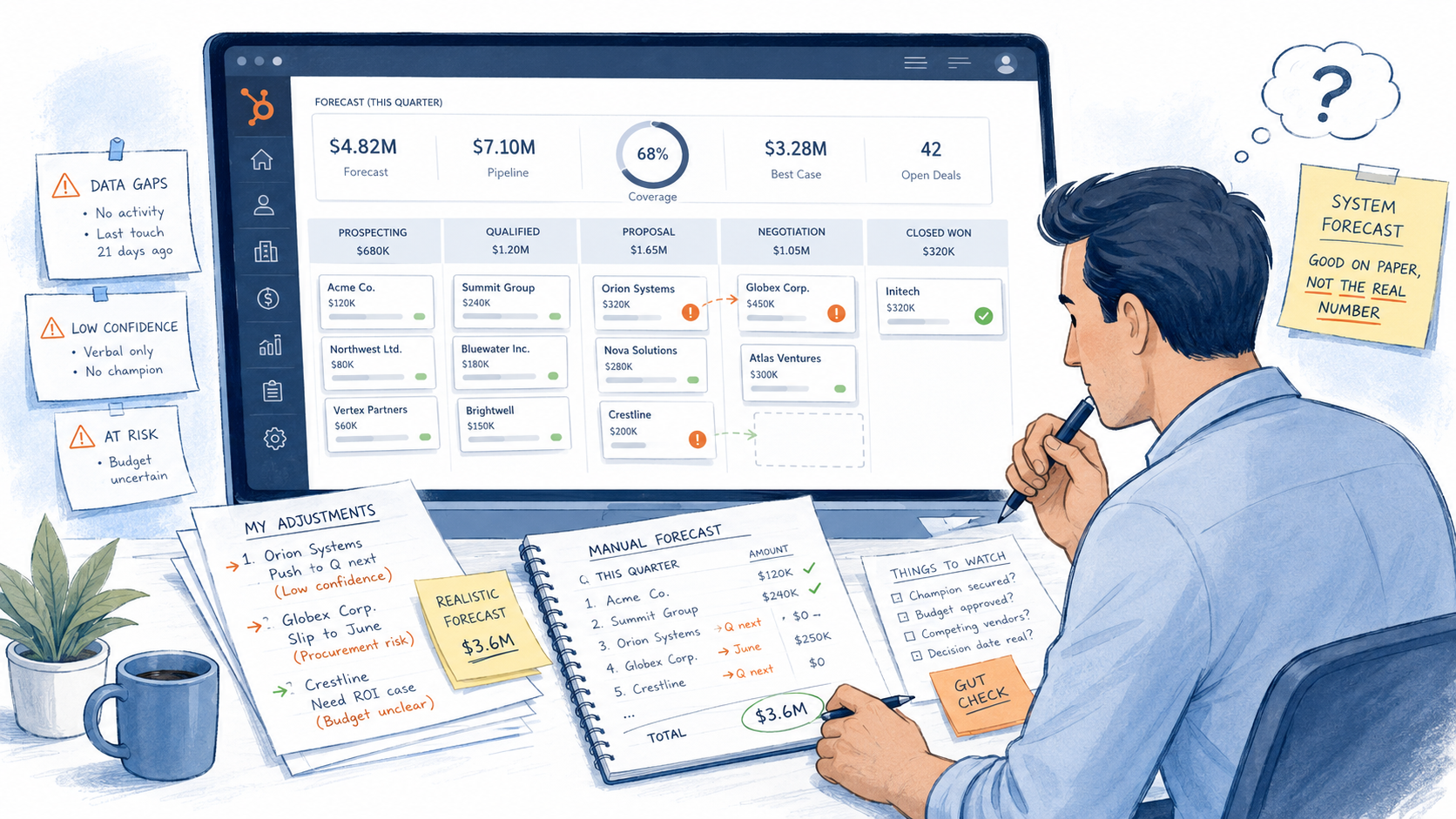
A sales forecast should not become credible only after the Sales Director has corrected it.
Yet that is what happens in many businesses using HubSpot. The dashboard presents one number, then leadership adjusts it using information that sits outside the system. One salesperson’s opportunities are discounted because they are known to be optimistic. Another deal is pushed into next month because the buyer has gone quiet, even though the close date has not changed. A large opportunity stays in the forecast because the team still believes it might return.
This is often described as experience or gut feel.
More often, it is Pipeline Drift.
The leader is compensating for stages, dates and forecast categories that no longer reflect commercial reality closely enough to support a reliable decision.
Commercial judgement should improve the forecast, not rebuild it
Experienced sales leaders should use judgement. Forecasting is not a mechanical calculation, particularly in complex B2B sales where decisions involve several people, internal politics, procurement and changing priorities.
A capable leader will notice risk that a dashboard cannot fully express. They may hear uncertainty in a salesperson’s explanation, recognise that a buyer has lost urgency or understand that a technically early-stage deal is commercially stronger than it appears.
That is useful commercial judgement.
The problem is different when the leader has to reconstruct the position of every important opportunity because the pipeline itself cannot be trusted.
They are no longer interpreting reliable evidence. They are replacing missing evidence with private knowledge, memory and personal adjustments.
The distinction matters.
Good judgement strengthens a credible forecast.
Gut-feel forecasting compensates for a weak one.
The forecast meeting reveals how far the pipeline has drifted
The real state of a forecast often becomes visible during the management meeting.
The team opens HubSpot and reviews the number. Then the corrections begin.
A deal in Commit is challenged because the buyer has not responded for two weeks. Another is removed because the proposal has not reached the final decision-maker. A large opportunity remains in the month despite having no agreed next step. One salesperson’s forecast is treated cautiously, while another person’s is accepted with far less challenge.
By the end of the meeting, the number leadership believes may be materially different from the number HubSpot showed at the start.
A good forecast meeting should challenge assumptions. That is part of management.
The warning sign is when the meeting has to repair the forecast before it can be used.
If the credible view only emerges after the Sales Director has applied knowledge that is absent from the records, HubSpot is not yet functioning as the management system.
It is providing the raw material for a second, private forecast.
Gut feel fills the gap left by weak buyer evidence
Forecast weakness usually begins before the forecast is produced.
It starts with how deals are allowed to move through the pipeline.
Many sales processes still use seller activity as a substitute for buyer progress. A discovery call has taken place. A demonstration has been delivered. A proposal has been sent. A follow-up task has been created.
These are legitimate sales activities, but they do not prove that the buyer has moved.
A proposal sent does not show that the buyer accepts the proposed solution.
A demonstration completed does not show that the wider decision group agrees there is a priority problem to solve.
A follow-up task does not show that the buyer has committed to a next step.
When stages are based mainly on what the salesperson has done, opportunities can move forward while the buyer remains in the same position.
That weakens the meaning of the stage. Once the stage becomes unreliable, the forecast category and close date become weaker too.
The Sales Director then has to inspect each deal personally and decide which parts of the pipeline they believe.
That is not a forecasting method.
It is a workaround for poor pipeline evidence.
A close date can look factual while being largely fictional
Close dates create false confidence because they appear precise.
A deal is expected to close on 30 September. The date is visible in HubSpot, included in the monthly forecast and presented to leadership as part of the expected revenue position.
But where did that date come from?
Sometimes it reflects a genuine buyer timetable. The decision meeting is booked, procurement is underway or the buyer has confirmed when the contract needs to begin.
In other cases, the date has been selected because it keeps the opportunity inside the current month or quarter. It may be based on the salesperson’s hope, the average sales cycle or the last working day of the reporting period.
The date still looks like data.
Leadership usually knows it is not reliable.
That is why dates are mentally adjusted during forecast reviews. The Sales Director remembers which opportunities have a real buyer deadline and which simply have a date in the record.
The problem is not that leaders question the date. They should.
The problem is that the evidence required to trust or reject it is not already clear inside the deal.
A close date without buyer evidence is not a commitment. It is an estimate presented with more certainty than it deserves.
Every salesperson can end up with a different forecasting system
Pipeline Drift also appears when forecast categories mean different things to different people.
One salesperson may only place a deal in Commit when the buyer has confirmed the commercial process and intended decision date. Another may use Commit when they feel confident the relationship is strong. A third may use it because the opportunity needs to appear in the month.
The same label is being used, but the evidence standard is different.
Sales leaders often compensate by applying personal weighting to each team member. They know who tends to overestimate, who is cautious and whose verbal confidence should be treated carefully.
A £500,000 forecast from one person may be treated as £300,000. A £300,000 forecast from another may be accepted almost in full.
This knowledge can help a leader arrive at a sensible number. It can also hide the fact that the business does not have one forecasting standard.
The final figure depends on informal judgements about the salesperson as much as formal evidence about the buyer.
That becomes harder to manage as the team grows. A Sales Director may be able to hold a detailed mental model of six people and a small number of major opportunities. It becomes far more difficult across several managers, regions or business units.
The forecast then depends on how well each manager interprets their team, how consistently they challenge evidence and how accurately that judgement is passed upwards.
The business has not created a scalable forecasting process. It has created a chain of personal adjustments.
More dashboards do not fix Pipeline Drift
When forecast confidence falls, the usual response is to improve reporting.
The business may add more dashboard views, introduce weighted pipeline calculations or create a separate board report. These changes can make the information easier to see, but they cannot repair weak evidence inside the opportunities.
A weighted forecast can apply mathematical confidence to an unreliable stage.
A more detailed report can still contain optimistic close dates.
A new dashboard can still summarise deals with no clear buyer next step.
The reporting is not necessarily wrong. It is accurately reflecting what the pipeline says.
That is why weak forecasting is rarely solved at the reporting layer alone.
The problem sits in the operating rules underneath it:
- what evidence allows a deal to move stage
- what each forecast category means
- how close dates are agreed
- what managers inspect
- when an opportunity moves backwards
- when a weak deal is closed out
If those standards are unclear, the dashboard simply presents Pipeline Drift more neatly.
The private forecast is a warning sign
Most experienced sales leaders carry a second version of the pipeline in their heads.
They know which deals are real, which are hopeful and which should have been closed months ago. They know which salespeople need challenging and which buyers have made genuine commitments.
Some level of contextual knowledge is inevitable.
The warning sign is when this private version is materially more useful than the shared system.
You may see this when:
- the forecast changes significantly during every review meeting
- leadership routinely discounts certain people’s pipelines
- close dates are pushed repeatedly without new buyer evidence
- opportunities remain open because no one wants to mark them lost
- managers use spreadsheets or personal notes to create the real forecast
- board numbers cannot be explained directly from HubSpot
These are not isolated data-quality problems.
They are signs that the agreed sales process, pipeline evidence and management rhythm have moved apart.
That is Pipeline Drift.
What I would test first
The first step is not to challenge the total forecast number.
Start with a small number of material deals and test the evidence behind them.
What has the buyer actually committed to?
Look for a specific action, decision or investment of time from the buyer. Avoid relying only on activity completed by the salesperson.
What proves the deal belongs in its current stage?
The evidence should describe the buyer’s current position, not simply explain which sales activity took place.
Where did the close date come from?
Was it agreed with the buyer, inferred from a known decision process or selected internally?
What has changed since the last review?
A deal can remain active in HubSpot while making no commercial progress.
What would cause the deal to move backwards?
If there is no clear answer, the pipeline may only permit optimism to accumulate.
Would another manager reach the same conclusion?
A shared process should allow two competent managers to review the same evidence and arrive at broadly similar judgements.
These questions expose whether the forecast is grounded in commercial evidence or depends on who happens to be reviewing it.
Better forecast confidence starts before the forecast meeting
A more reliable forecast does not remove management judgement.
It gives leaders stronger evidence to judge.
The pipeline should provide a credible starting point. Stages should reflect buyer progress. Forecast categories should have shared meanings. Close dates should be connected to a genuine buyer process wherever possible. Managers should inspect the same evidence consistently.
Deals should also be able to move backwards.
This matters because commercial reality does not only move towards a sale. Priorities change, stakeholders leave, funding disappears and buyers stop responding. A pipeline that only allows forward movement gradually fills with confidence that is no longer justified.
When the evidence standard is clear, the forecast meeting changes.
Managers no longer spend most of the meeting deciding whether the data can be believed. They can focus on risk, action, coaching and commercial decisions.
The Sales Director still applies experience. But they are interpreting the evidence, not rescuing the system.
The forecast should survive without one person’s memory
A forecast that depends heavily on one experienced leader may still look accurate.
The Sales Director knows the team, understands the buyers and can identify which opportunities deserve confidence. They compensate for weak stages, poor dates and inconsistent qualification.
The danger is that the business mistakes this compensation for a working process.
The system is not working.
The leader is working around it.
That creates a dependency. Forecast confidence weakens when the leader is absent, the team grows or responsibility passes to another manager. Coaching standards vary because the real rules are held informally. Board reporting becomes difficult to explain because the final number cannot be traced back to a consistent evidence standard.
A credible pipeline should retain its meaning when responsibility changes.
It should not depend on one person remembering the truth behind every deal.
When gut feel is essential, Pipeline Drift has already taken hold
Commercial judgement will always matter in sales forecasting.
No CRM can remove uncertainty from a complex buying process. No set of fields can replace experienced leadership.
But the role of judgement should be to interpret credible evidence, challenge risk and guide action.
It should not be to correct a pipeline that no longer reflects buyer reality.
When the Sales Director has to discount deals, rewrite close dates, reinterpret forecast categories and remember missing buyer context before the number can be trusted, Pipeline Drift has already taken hold.
The answer is not to remove judgement.
It is to rebuild the pipeline evidence, operating rules and management rhythm so judgement no longer has to replace the system.
Take the Pipeline Snapshot
The Pipeline Snapshot helps sales leaders identify where Pipeline Drift may be weakening buyer evidence, deal movement, forecast confidence and management control.