
Implement HubSpot Properly
HubSpot rarely fails because of features.
It fails when it’s implemented without a management operating model.
Proper implementation translates leadership standards into CRM structure.
When structure is right, adoption follows.
See how Build supports adoption and growth:
On the page:
What properly means | Why adoption breaks | Where MLA fits | FAQs
At a glance
What this is
A structured approach to aligning HubSpot architecture with leadership-defined operating standards.
Who it’s for
Leadership teams implementing HubSpot for the first time or rebuilding a fragmented system.
The problem it solves
Inconsistent usage, unreliable reporting and CRM distrust caused by poorly structured implementation.
How it fits the CONVRG Method
This hub covers the Build phase of The CONVRG Method →
The Build Stage of the CONVRG Method
Implement HubSpot Properly is the pillar for the Build stage of the CONVRG Method. In CONVRG, HubSpot implementation is not simply about configuring software. It is about translating leadership standards into system architecture so the CRM reinforces how the business actually operates.
The CONVRG Method progresses through four stages:
Plan
Leadership defines CRM standards, forecasting logic and management expectations.
Build (Implement HubSpot Properly)
HubSpot is configured to enforce those standards through pipelines, reporting structures, properties and automation.
Adopt
Managers reinforce usage through inspection, forecasting and coaching inside the system.
Grow
Sales execution, SEO, website performance and pipeline visibility improve because the business is now operating on a stable CRM foundation.
Learn more about the full CONVRG Method →
Proper implementation is not:
Proper implementation means:
Reinforcing adoption through leadership
HubSpot becomes part of how the business runs.
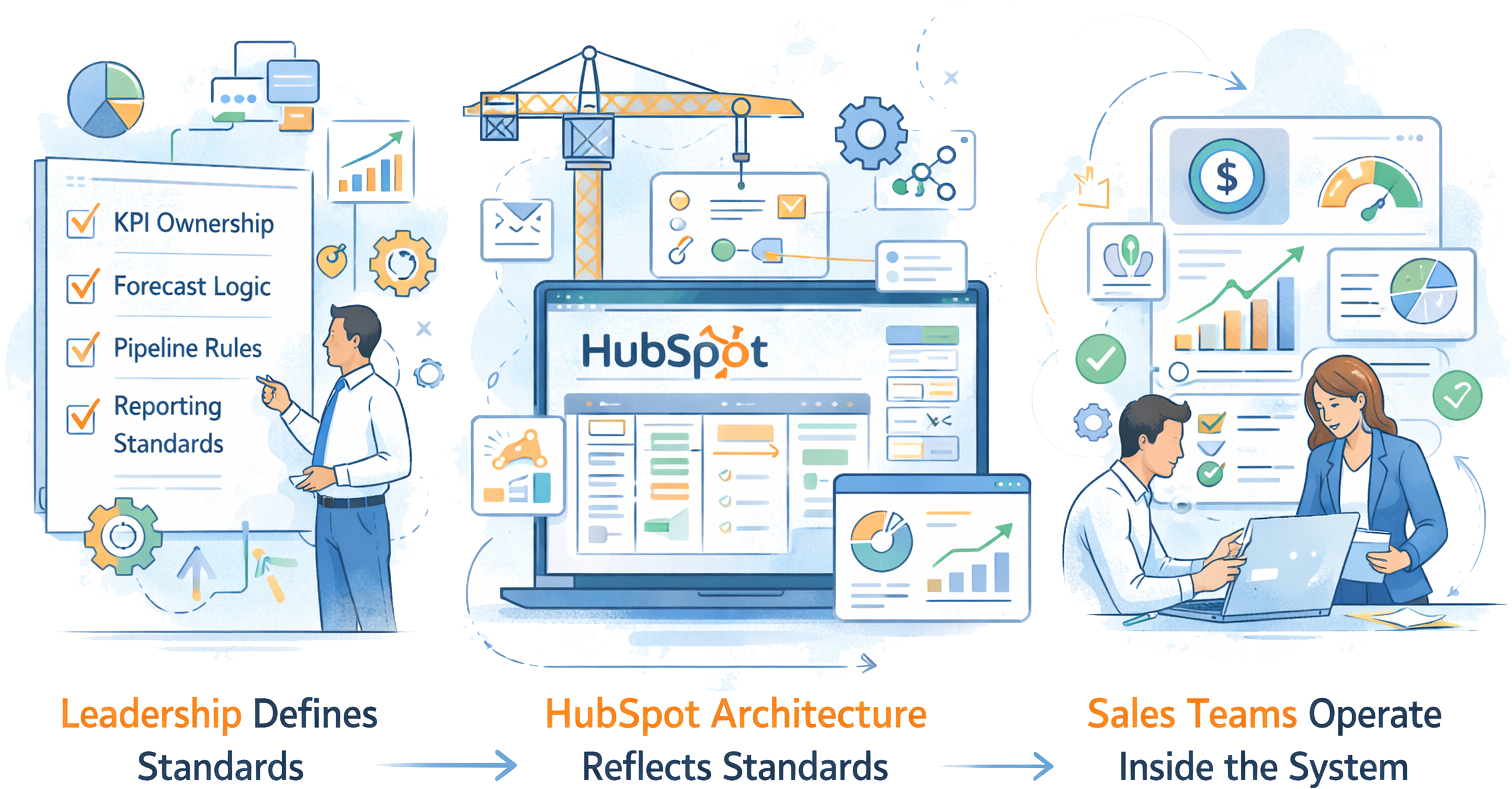
Structure Comes Before Services
Implementation, integrations and onboarding are not standalone fixes.
They only work when anchored in a Management-Led Adoption model.
Without leadership ownership, clear inspection standards and defined reporting discipline, adding more services simply scales confusion.
Management standards come first.
Services reinforce them.
These layers exist only to reinforce leadership-defined standards. These services only work when the management structure exists first.
Need something fixed quickly?
If your HubSpot setup is already structured, targeted fixes can help improve specific areas quickly.
If not, they often highlight where a more complete approach is needed.
Need something implemented quickly?
If your processes, ownership and reporting are already defined, we can implement them as scoped work inside HubSpot.
If not, this often highlights where a more structured approach is needed first.
Why HubSpot Adoption Breaks After Implementation
Many organisations believe their HubSpot implementation is complete once pipelines, properties and automation are configured.
However, CRM adoption often begins to break down shortly after launch.
This usually appears as:
Inconsistent deal updates
Unreliable forecasting
Sales teams managing pipeline outside the CRM
Leadership losing confidence in reporting
These issues rarely come from the software itself.
They occur when the CRM was configured before leadership standards for pipeline inspection, forecasting and reporting were clearly defined.
In other words, the system was implemented before the management model existed.
This is known as the HubSpot Adoption →
The Layers That Reinforce Management-Led Adoption
These layers exist to reinforce leadership-defined standards, not to expand configuration complexity.
1️⃣ HubSpot Implementation
Build the CRM structure around real processes and reporting standards.
Includes:
Pipeline architecture
Property structure
Forecasting logic
Management dashboards
Data governance
2️⃣ HubSpot Integrations
Connect systems without fragmenting reporting or creating duplicate data.
Includes:
Finance integration
Product system integration
Support platform connection
Reporting coherence design
Explore HubSpot Integrations →
3️⃣ HubSpot Onboarding
Embed behavioural standards so usage becomes consistent and measurable.
Includes:
Manager-first enablement
Usage standards
Inspection cadence
Behavioural reinforcement
Explore HubSpot Onboarding →
How This Connects to Management-Led Adoption
HubSpot implementation without leadership ownership does not last.
Adoption without structure collapses under growth.
Management-Led Adoption ensures:
Managers inspect inside HubSpot
Standards are enforced
Reporting is trusted
Usage survives team changes
Related:
Management-Led Adoption →
Why Leadership Teams Choose CONVRG
Management-first architecture
Structured CRM operating model
Proven forecasting restoration
HubSpot implemented for scale
HubSpot adopted by management first
Four types of business we really know
Sport
We have a lot of friends in the world of Sports so if you are looking for an agency that understands sports marketing sponsorship and hospitality sales we might be the one! From professional teams to NGO's we help your team win.
Not For Profit
We have worked with Charities, arms-length bodies and Foundations of many types and understand the pressures of the third sector as well as anyone. we can help with your data, fundraising and events management
Technology
From high-tech manufacturing to SAAS Startups. we've worked with lots of businesses in this arena. We can help with audience building, monetisation, sales process and so on. It helps to be a technology business ourselves!
Media
The roots of Real Inbound run deep into the world of media and the music industry, and always with a commercial aspect driven by the acquisition and monetisation of huge audiences through first-rate content strategies.
Implementing HubSpot properly means designing CRM architecture around leadership standards such as forecasting, pipeline governance and reporting accountability.
Most implementations fail because the CRM is configured before leadership standards are defined.
HubSpot CRM architecture refers to the structure of pipelines, properties, reporting frameworks and automation that enforce how the business manages revenue.