6min
6min
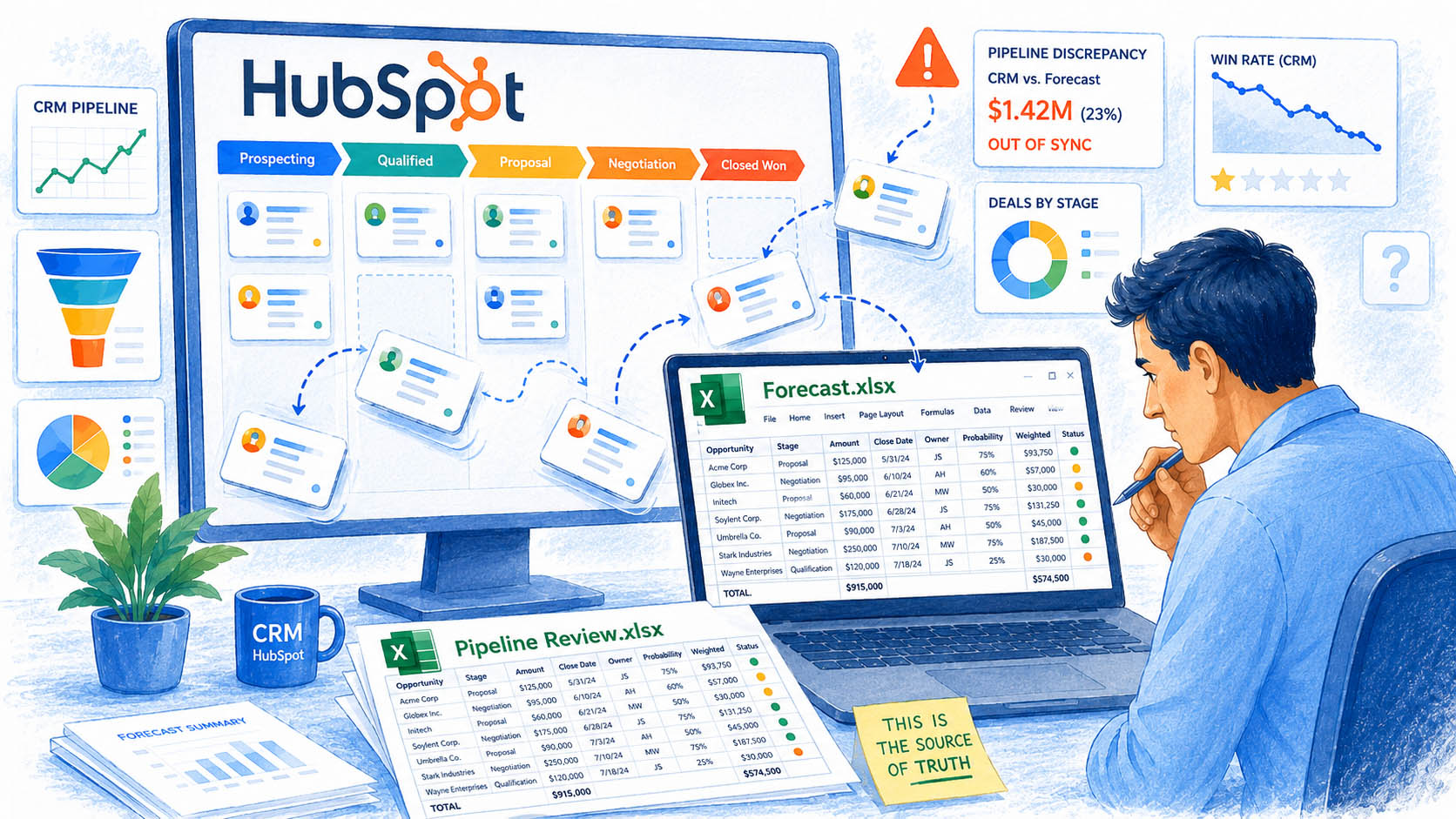
A pipeline can look busy without being reliable.
There may be plenty of deals in HubSpot. Reps may be logging activity. The dashboard may show a healthy pipeline value. But when the sales leadership team sits down to review the forecast, the real conversation happens somewhere else.
A spreadsheet. A notebook. A side report. A series of judgement calls based on what individual reps say they know.
That is often a sign of Pipeline Drift.
Pipeline Drift happens when your pipeline stages, deal values, sales activity and forecast no longer reflect what is really happening with buyers.
The pipeline still exists. HubSpot still contains data. But the system is no longer giving managers a dependable view of commercial reality.
This matters because a pipeline should not simply record what the sales team has done. It should show what buyers have committed to, what decisions are likely next and where revenue risk is building.
When that link breaks, leaders lose control.
Pipeline Drift is not just poor CRM hygiene
It is easy to describe Pipeline Drift as a data quality problem.
Salespeople have not updated their deals. Close dates are wrong. Opportunity values are inflated. Stages have not moved for weeks.
Those things matter. But they are usually symptoms, not the full explanation.
The deeper issue is that the sales team and its managers do not have a shared operating standard for what the pipeline is meant to show.
For example:
- One rep moves a deal to “Proposal Sent” when they have emailed a document.
- Another only moves it when the buyer has agreed the scope and confirmed the decision process.
- A manager treats a late-stage deal as likely to close because the relationship is strong.
- Another manager sees the same deal as at risk because no budget has been confirmed.
All four people may be acting in good faith.
But the pipeline is no longer measuring the same thing for everyone.
That is Pipeline Drift.
It is what happens when the sales process in HubSpot gradually separates from the way buyers actually move towards a decision.
Take the Pipeline Drift Snapshot →
The signs are usually visible before anyone names the problem
Most leadership teams do not wake up one day and decide they have Pipeline Drift.
They notice smaller frustrations first.
The forecast changes significantly during the meeting.
Deals remain open because nobody is sure whether they are genuinely active or simply difficult to close out.
A rep says a deal is “looking positive”, but the record does not show a confirmed next step, decision date or clear buyer commitment.
Managers ask for a separate spreadsheet because the HubSpot report does not feel trustworthy enough.
Pipeline stages begin to mean different things to different people.
The business starts discussing the pipeline through personal judgement rather than shared evidence.
None of these signs automatically mean the CRM is broken.
They do mean that the relationship between process, management and HubSpot needs attention.
A useful test is simple:
Could two managers look at the same deal record and reach the same conclusion about its health, stage and likely next step?
If the answer is no, the pipeline is probably drifting.
A deal stage is not proof of buyer progress
One of the most common causes of Pipeline Drift is that deal stages become a record of sales activity rather than buyer progress.
For example, these are common internal actions:
- Discovery call completed
- Demonstration delivered
- Proposal sent
- Quote issued
- Follow-up scheduled
They are useful milestones. But on their own, they do not prove that the buyer has moved closer to a decision.
A proposal being sent does not prove that the buyer agrees the problem is urgent.
A quote being issued does not prove that budget is available.
A demonstration completed does not prove that the decision-maker has been involved.
A follow-up booked does not prove that there is a credible next step.
The distinction matters because forecasts depend on buyer commitment, not sales effort.
A reliable pipeline needs stages that are supported by evidence. That evidence might include an agreed problem, defined decision criteria, confirmed stakeholders, budget confidence, a realistic decision process or a committed next action.
The exact evidence will vary by business. The principle does not.
A deal should move forward because something meaningful has changed in the buyer’s position, not simply because the sales team has completed another task.
Take the Pipeline Drift Snapshot →
Why Pipeline Drift weakens forecast confidence
Forecasting is often treated as a reporting exercise.
Leaders ask for a clearer dashboard, a new forecast category or a better way to weight pipeline values.
Those tools can help. But they cannot repair a pipeline that is based on unclear stage definitions or inconsistent judgement.
A forecast is only as reliable as the evidence behind each deal.
When stage movement is inconsistent, forecast categories become subjective.
When close dates are not challenged, the pipeline becomes inflated.
When managers rely on verbal updates rather than the CRM record, HubSpot becomes a partial reference point rather than the management system.
That creates a difficult position for leadership.
They may have access to more data than ever, while still having less confidence in the numbers.
This is why Pipeline Drift has a commercial consequence. It affects decisions about hiring, resourcing, production, cash flow, marketing investment and sales targets.
A forecast does not need to be perfect to be useful.
But leadership needs to understand where confidence is strong, where risk is building and what evidence supports the numbers.
Pipeline Drift makes that much harder.
Why more training usually does not solve it
When CRM usage is inconsistent, the natural response is often more training.
Teams may be shown how to update deals, create tasks, log calls or use dashboards more effectively.
That can improve capability. It does not automatically create adoption.
The issue is that people will only treat HubSpot as important when it is clearly connected to how the business is managed.
If a sales manager still asks for a separate spreadsheet before the forecast meeting, the team learns that the spreadsheet is where the real accountability sits.
If deal stages are not challenged in pipeline reviews, reps learn that stage accuracy is optional.
If managers do not use the CRM record to coach, question and make decisions, the system becomes an administration task.
That is why CONVRG sees HubSpot adoption as a management issue before it is a training issue.
Managers need a shared view of what the pipeline should show, what evidence is expected and how they will use the information in their sales rhythm.
Once that is in place, training has a clearer purpose.
Without it, training often adds more activity without creating more control.
Take the Pipeline Drift Snapshot →
Pipeline Drift is often a management rhythm problem
A pipeline is not made reliable by its fields alone.
It becomes reliable through repeated management behaviour.
That includes:
- Reviewing the right deals at the right time
- Asking for buyer evidence, not optimistic summaries
- Challenging unsupported close dates
- Agreeing what stage movement means
- Closing out deals that are no longer real
- Using HubSpot as the record that supports the conversation
- Creating a consistent follow-up rhythm when risks emerge
This is the management rhythm behind a healthy pipeline.
It is what turns HubSpot from a place where sales data is stored into a system that helps leadership run the business.
When that rhythm weakens, Pipeline Drift begins.
The CRM may still be live. The reports may still be available. But the rules and behaviours that make the data meaningful are no longer being applied consistently.
Five questions that reveal Pipeline Drift
You do not need a full audit to spot the early signs.
Start with these questions.
1. What evidence proves a deal belongs in its current stage?
If each rep or manager gives a different answer, the stage is not operating as a shared commercial standard.
2. How often do forecast meetings move outside HubSpot?
A side spreadsheet may be useful for a specific analysis. But if it becomes the real source of truth, HubSpot is not yet acting as the management system.
3. Are close dates based on buyer commitments or sales hope?
A date should reflect something real in the buyer’s decision process. It should not exist simply because the rep needs a date in the system.
4. Can managers explain why a deal has moved forward?
“Because we had a good call” is not enough. What changed in the buyer’s understanding, commitment or decision process?
5. What happens to deals with no clear next step?
If they stay open indefinitely, the pipeline will become larger but less useful.
These questions do not diagnose every issue. They do help leadership see whether the pipeline is reflecting real buyer progress or internal sales activity.
What better looks like
A healthier pipeline does not mean a more complicated pipeline.
It means everyone understands what each stage represents and what evidence is needed before a deal moves forward.
It means managers review the same information in the same way.
It means close dates are challenged when they are unsupported.
It means forecast conversations begin with buyer reality, not rep optimism.
It means HubSpot is used during management conversations because the information inside it can be trusted.
Most importantly, it means the sales team sees the CRM as part of how the business runs, not as a separate administrative task.
That is the difference between having a pipeline and having pipeline control.
Pipeline Drift is a signal, not a verdict
Seeing Pipeline Drift does not mean your sales team is failing.
It does not mean HubSpot was the wrong choice.
It means the business may have outgrown the way its sales process, management rhythm and CRM structure currently work together.
That is common.
The important question is whether leadership can see the issue early enough to correct it.
Because when Pipeline Drift goes unaddressed, the business often ends up with more sales activity, more reports and more meetings, but less confidence in what is actually likely to happen.
The Pipeline Drift Snapshot gives you a quick way to test where that risk may be appearing in your own business.
Take the Pipeline Drift Snapshot
If your sales pipeline looks active but your forecast still depends on spreadsheets, gut feel or manual adjustment, the Pipeline Drift Snapshot can help you identify where control may be weakening.
It takes around five minutes and looks at six areas that commonly affect pipeline trust, sales management and forecast confidence.