6min
6min
Your Pipeline Should Measure Buyer Commitment
A busy pipeline can still be a weak pipeline.
Reps can make calls, send emails, book meetings, update tasks, issue proposals and move deals through HubSpot. On the surface, everything looks active.
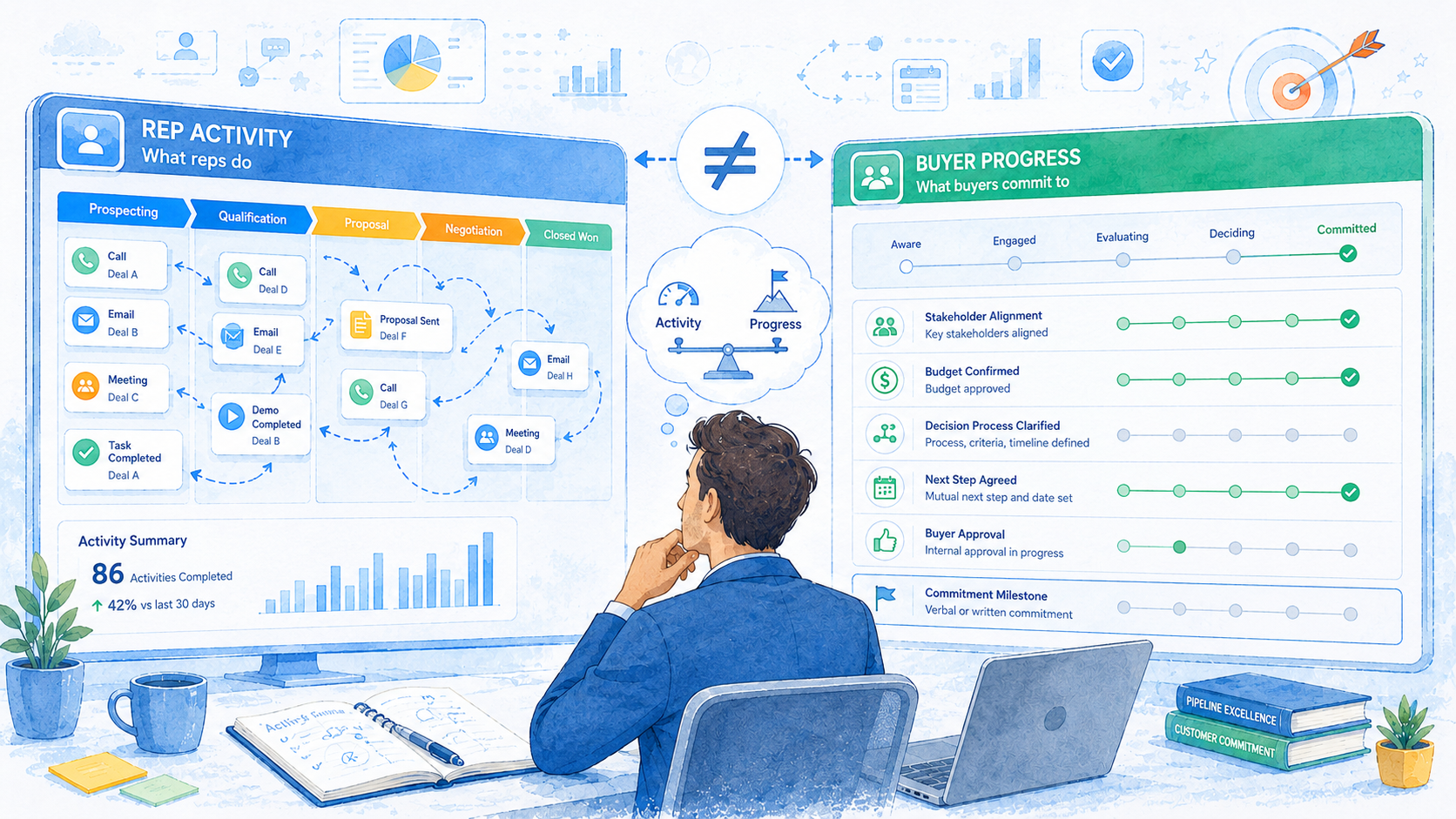
But activity is not the same as progress.
A deal has not moved forward because a salesperson completed an action. It has moved forward when the buyer has shown clearer commitment.
That distinction matters.
If your pipeline stages are based mainly on what your sales team has done, your forecast will often feel more confident than it should. If your stages are based on what the buyer has proved, the pipeline becomes much more useful for management.
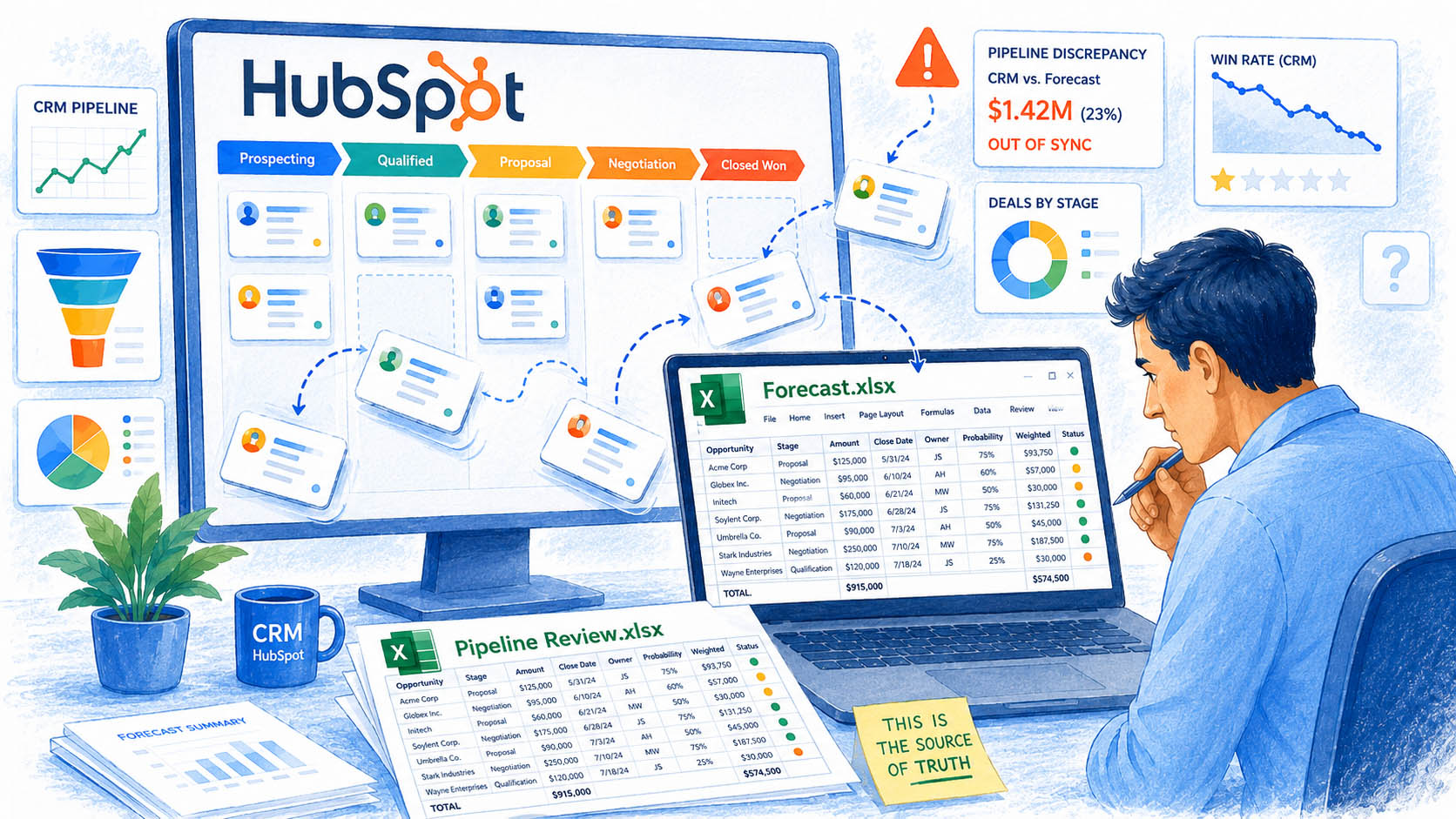
This is one of the clearest signs of Pipeline Drift: HubSpot is full of activity, but the business still cannot fully trust what the pipeline is saying.
Why activity-based pipelines create false confidence
Many sales pipelines are built around internal activity.
A deal moves forward because:
- A discovery call happened
- A demo was delivered
- A proposal was sent
- A follow-up task was completed
- A quote was issued
- A sales rep feels the conversation is positive
These things matter. They are useful signals.
But they do not prove the buyer has moved.
A proposal sent is not proof that the buyer agrees on value.
A demo completed is not proof that the buying group is aligned.
A quote issued is not proof that budget is approved.
A positive call is not proof that there is a real decision process.
When pipeline stages are based on rep activity, the CRM can start to look healthier than the commercial reality behind it. Deals appear further along than they really are. Forecast categories become optimistic. Managers have to ask more questions outside HubSpot because the stage alone does not tell them enough.
This is how a pipeline can look busy but still be unreliable.
Buyer commitment is the evidence that matters
A stronger pipeline asks a different question.
Not:
What has the sales rep done?
But:
What has the buyer committed to?
Buyer commitment can show up in several ways.
For example:
- The buyer has confirmed the business problem
- The buyer has agreed the commercial impact
- The buyer has shared the decision process
- The buyer has introduced other stakeholders
- The buyer has confirmed budget or funding route
- The buyer has agreed a clear next step
- The buyer has accepted the proposed timing
- The buyer has explained what could stop the deal
- The buyer has taken an action between meetings
This is the kind of evidence that gives a pipeline stage meaning.
It does not remove judgement. Sales will always involve judgement. But it gives managers something more reliable to inspect than optimism, activity or a general feeling that “the deal is going well”.
A deal stage should prove something
Every pipeline stage should answer a simple question:
What must be true for a deal to belong here?
If that question cannot be answered clearly, the stage is probably too weak.
Take a common stage such as “Proposal Sent”.
In many businesses, a deal moves into that stage when the sales rep sends the proposal. That sounds logical, but it is still activity-based.
A stronger version would ask:
- Has the buyer agreed the problem this proposal addresses?
- Has the buyer confirmed who needs to review it?
- Has the buyer explained how the decision will be made?
- Has the buyer agreed when feedback will happen?
- Is there a next meeting in the diary?
- Do we know what would stop this progressing?
That changes the meaning of the stage.
The proposal is no longer just a document sent by the seller. It becomes part of an agreed buying process.
That is a much better basis for management confidence.
Why this matters in HubSpot
HubSpot can show pipeline value, deal stage, close date, forecast category, activity history and next steps.
But HubSpot cannot decide what those things should mean inside your business.
That has to be defined by leadership and management.
If one sales rep moves a deal forward after a good call, another moves it forward after budget is confirmed, and another waits until procurement is involved, the pipeline will not be consistent.
The dashboard may still work. The reports may still load. The automation may still trigger.
But the management meaning is weak.
That is why pipeline problems often get blamed on HubSpot when the real issue sits underneath the platform. The business has not defined the buyer evidence required at each stage.
HubSpot is only showing the inconsistency.
The commercial consequence of weak buyer evidence
Weak buyer evidence creates several problems for leadership.
Forecast confidence drops
If deal stages are based on activity rather than commitment, the forecast becomes harder to trust.
The numbers may look strong, but managers still need to ask:
- Is this really at this stage?
- Has the buyer committed to anything?
- Is the close date real?
- Is the value still accurate?
- What changed since last week?
When those questions happen outside HubSpot, the CRM is no longer acting as the management system.
Pipeline reviews become repetitive
Managers end up asking the same questions every week because the answers are not visible in the deal record.
The meeting becomes a verbal update, not a management review.
That slows decisions and weakens accountability.
Deals stay alive too long
If buyer commitment is not required, weak deals can remain in the pipeline long after momentum has gone.
They are not closed out because there is no clear evidence standard to challenge them.
This inflates pipeline value and hides risk.
Coaching becomes harder
Managers cannot coach effectively if they cannot see where the buyer is really stuck.
The issue may not be “follow up more”.
It may be that the buyer has not confirmed urgency, budget, authority, timing or decision criteria.
Different problem. Different coaching conversation.
Practical test: inspect one stage
You do not need to redesign your whole pipeline to spot the issue.
Start with one stage.
Choose the stage where forecast confidence usually starts to weaken. For many businesses, this is somewhere around qualified opportunity, proposal, negotiation or commit.
Then ask:
- What does this stage currently mean?
- Is it based on seller activity or buyer evidence?
- What must the buyer have confirmed?
- What must be visible in HubSpot?
- Would two managers interpret this stage in the same way?
- What would cause a deal to move backwards or be removed?
- Does the forecast rely on this stage being accurate?
If the answers are vague, the stage is not strong enough to support management confidence.
That does not mean your sales team is doing something wrong. It means the operating rules are not clear enough.
What better looks like
A healthier pipeline has fewer assumptions hidden inside it.
Each stage has a clear purpose.
Each movement has evidence behind it.
Managers know what to inspect.
Reps know what is expected before a deal moves forward.
Forecast conversations are based on buyer reality, not just sales activity.
In practice, that means HubSpot becomes more than a place where people record work. It becomes the place where the business can see what is actually happening.
A strong pipeline does not just answer:
What are our salespeople doing?
It answers:
Where are buyers genuinely moving forward, where are they stuck, and what does that mean for the forecast?
That is the difference between a CRM database and a management system.
Why CONVRG looks at buyer evidence first
At CONVRG, we see many HubSpot problems that first appear as reporting, adoption or pipeline issues.
But when you look more closely, the issue often starts with weak operating definitions.
The business has pipeline stages, but not enough agreement about what those stages prove.
The team has activity data, but not enough buyer evidence.
Managers have dashboards, but not enough confidence that the information reflects commercial reality.
That is why we do not treat pipeline repair as a dashboard exercise alone.
The important work is defining how the business should manage deal movement, what evidence matters, how managers should challenge it, and how HubSpot should support that rhythm.
FAQs
What is buyer evidence in a sales pipeline?
Buyer evidence is proof that the buyer has moved forward in their decision process. It might include confirmed need, agreed next steps, budget discussion, stakeholder involvement, decision criteria or a clear buying timeline.
Why is rep activity not enough for forecasting?
Rep activity shows what the sales team has done. Forecasting needs to understand what the buyer is likely to do. A high level of activity can still sit around a deal with weak commitment.
Should we stop tracking sales activity in HubSpot?
No. Sales activity is still useful. The problem comes when activity is treated as proof of progress. Activity should support the deal record, but buyer commitment should guide stage movement and forecast confidence.
How do we know if our pipeline stages are too weak?
Ask two managers to review the same deal and decide whether it belongs in the current stage. If they need extra verbal explanation or reach different conclusions, the stage definition is probably unclear.
Can HubSpot enforce buyer evidence?
HubSpot can support the rules through properties, required fields, playbooks, automation and reporting. But the business has to define the rules first. The system cannot replace management judgement.
Final thought
Your pipeline should not only show what your sales team has done.
It should show what your buyers have committed to.
That is what gives HubSpot management value.
Without buyer evidence, pipeline stages become labels. Forecasts become opinions. Reviews become repeated verbal updates. Managers end up working around the CRM because the system does not give them enough confidence.
When buyer commitment is clear, HubSpot becomes more useful. Not because there is more data, but because the data means something.
Start the Pipeline Snapshot
If your pipeline is active but still hard to trust, there may be Pipeline Drift beneath the surface.
The Pipeline Snapshot helps you see where drift may be happening across deal movement, buyer evidence, forecast confidence and management rhythm.