3min
3min
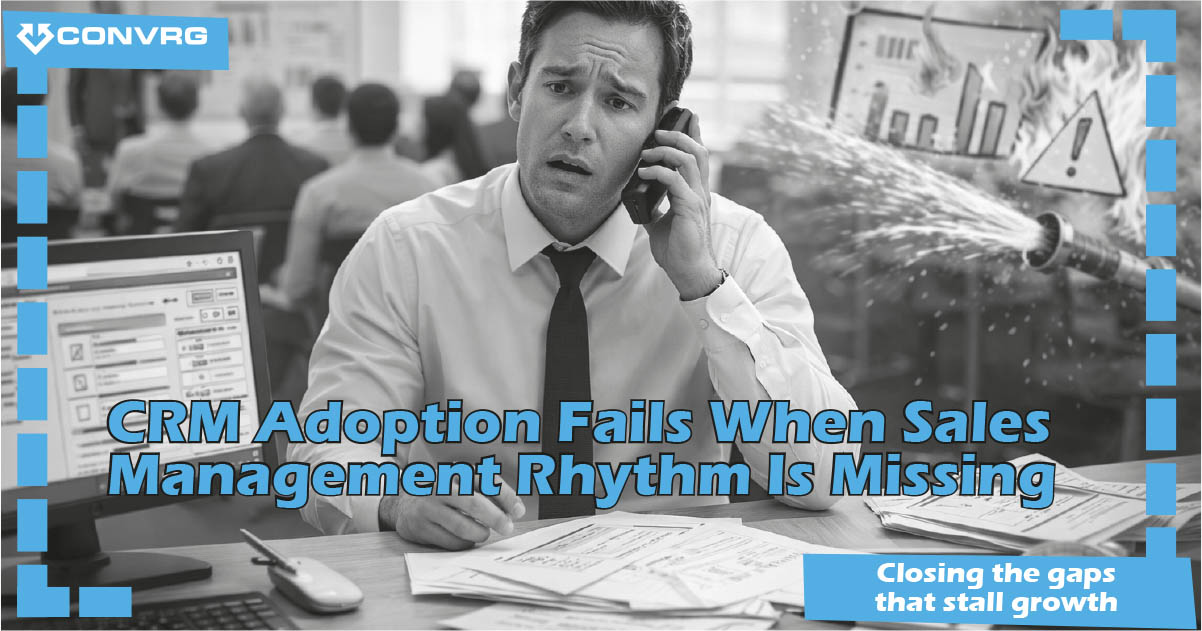
CRM adoption does not usually fail because the system is badly configured.
It fails because it is not led.
In many organisations, CRM implementation is treated as a technical milestone. Once the system is live and training is delivered, success is assumed. Dashboards exist, reports run, and leadership expects clarity to follow.
In practice, this is where most adoption problems begin.
The difference between implementation and adoption
Implementation is about getting a system live.
Adoption is about how people actually use it when pressure returns.
Most CRM programmes invest heavily in configuration, onboarding, and training. Much less time is spent defining how sales managers are expected to use the system day to day.
As a result, there is a gap between what the CRM is capable of and how it is actually used.
That gap grows quietly.
Where CRM adoption really breaks down
CRM adoption rarely fails at rep level.
It fails at management level.
Sales managers are responsible for:
- Coaching performance
- Reviewing pipeline
- Forecasting outcomes
- Reporting upwards with confidence
At the same time, many inherit:
- Pipelines they did not design
- Reports that do not reflect how they manage
- CRM setups built around rep activity, not management judgement
When the system does not reliably support management decisions, managers adapt.
They create spreadsheets. They ask for verbal updates. They rely on instinct instead of data.
None of this is intentional resistance.
It is a response to pressure.
Why training alone does not change behaviour
Most CRM training focuses on knowledge transfer.
How to log activity.
How to update deals.
How to use features correctly.
What it rarely addresses is how CRM fits into:
- Weekly pipeline reviews
- Forecast conversations
- Coaching routines
- Performance management
Without this integration, training impact fades quickly.
Behaviour follows leadership behaviour, not documentation.
If pipeline reviews happen outside the CRM, the CRM becomes optional.
If forecasts are rebuilt manually, the system loses credibility.
Once credibility is lost, adoption follows.
The management rhythm problem
Management rhythm is the repeated pattern of how sales managers run their week.
What they look at.
What they ask about.
What they challenge.
What they reinforce.
In organisations where CRM adoption works long term, the system sits at the centre of this rhythm.
Pipeline reviews happen in the CRM.
Coaching conversations reference CRM data.
Forecasts are discussed using live dashboards.
In organisations where adoption fails, the CRM sits to one side.
Used occasionally. Updated reluctantly. Trusted inconsistently.
The difference is not technology.
It is rhythm.
Why CRM platforms struggle to support managers by default
Most CRM platforms are designed primarily for reps.
They track activity well. They capture deals. They log communication.
Sales managers, however, need something different.
They need:
- Signals they can trust
- Visibility into what is working and what is not
- Forecasts they can defend
- A way to coach using evidence rather than anecdotes
When the system does not provide this confidently, managers work around it.
Over time, parallel systems appear.
And once parallel systems exist, the CRM becomes secondary.
The cost of unmanaged CRM adoption
The cost of poor adoption is not just messy data.
It is decision fatigue.
When managers cannot rely on the system, every decision takes more effort. Forecasts require manual checking. Pipeline reviews become subjective. Coaching loses structure.
Confidence erodes.
Not just in the CRM, but in leadership conversations themselves.
What sustainable CRM adoption actually looks like
When CRM adoption works, a few things are consistently true.
Sales managers:
- Run pipeline reviews directly inside the system
- Use CRM data to guide coaching conversations
- Trust dashboards enough to act on them
- Forecast without rebuilding numbers elsewhere
As a result:
- Reps know what matters
- Data quality improves naturally
- Management conversations become more consistent
- Forecasting becomes more predictable
Adoption becomes self reinforcing.
Not because people are forced to use the system, but because it becomes useful.
A management led approach to CRM
CRM adoption becomes sustainable when sales managers are equipped to lead it as part of their role.
That means:
- Clear expectations of how CRM is used in management routines
- Repeatable structures for reviews and forecasting
- Practical coaching frameworks supported by real data
- Systems aligned to how managers actually work
This is the gap most organisations never formally address.
Why this matters now
As CRM platforms add more automation and AI capability, this gap matters even more.
Without management rhythm, new features add noise.
With rhythm, they support better judgement.
Technology amplifies leadership behaviour. It does not replace it.
How we are addressing this gap
We have built a live, cohort-based programme focused entirely on this management challenge.
HubSpot for Sales Managers is designed for sales leaders who already use HubSpot but want a clearer, more repeatable way to run their teams through it.
It focuses on:
- Leading CRM usage without micromanaging
- Running pipeline and forecast reviews with confidence
- Coaching using data managers can trust
- Turning HubSpot into a management control system
The first cohort starts on 4 February.
Final thought
CRM adoption does not stick because people are trained.
It sticks because management rhythm makes it unavoidable.