4min
4min
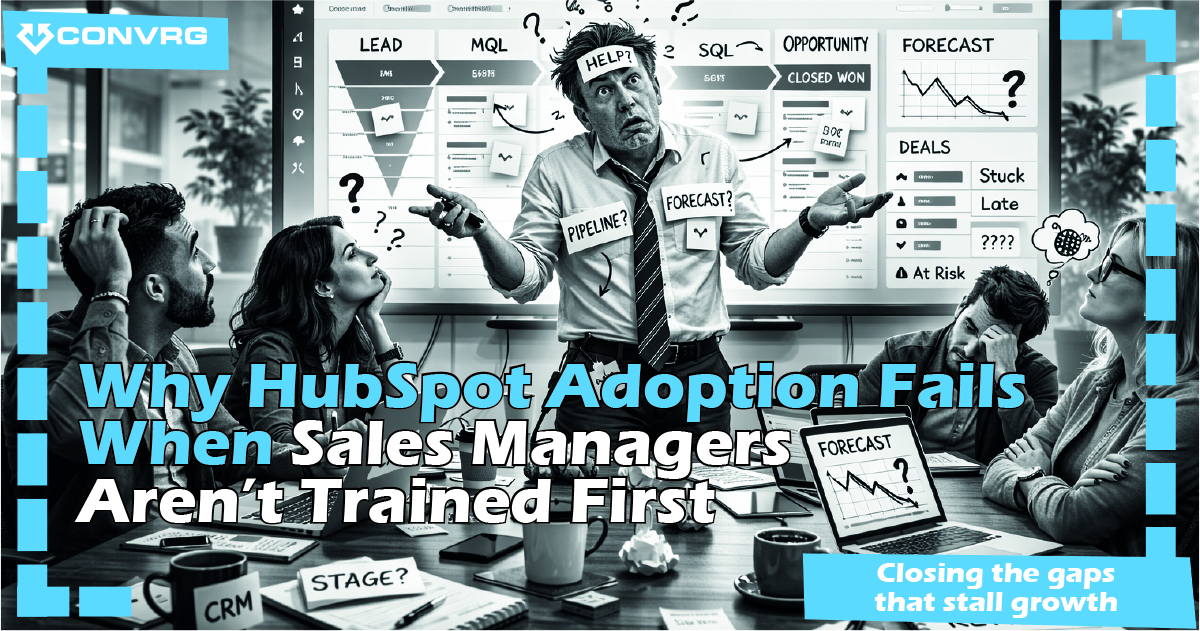
Most CRM failures do not begin with software.
They begin with management.
- Companies invest heavily in HubSpot.
- They onboard their teams.
- They run a few training sessions.
- Dashboards are built.
- Pipelines are configured.
For a while, everything looks healthy.
Then something subtle happens.
- Pipeline reviews move to slides.
- Forecasts get “sense checked” in spreadsheets.
- Stage definitions drift between reps.
- Dashboards exist, but they stop driving decisions.
No one announces that adoption is declining.
It simply erodes.
And in most cases, the reason is the same.
Sales Managers were never trained to lead inside HubSpot.
The Illusion of “Training Complete”
There is a dangerous phrase in CRM projects:
“We’ve trained the team.”
- It sounds responsible.
- It sounds finished.
- It sounds reassuring.
But CRM training is not a milestone.
It is a management rhythm.
When companies say they have trained the team, what they usually mean is:
- Reps attended a session
- Features were explained
- A certification was completed
- A launch date was announced
That is education.
It is not operating discipline.
The real question is not:
“Do your reps know how to use HubSpot?”
The real question is:
“Do your Sales Managers know how to run the business inside HubSpot?”
If the answer is no, adoption will not hold.
Because behaviour in sales organisations is set by managers, not by software.
What Quiet Adoption Decay Actually Looks Like
CRM decay rarely looks dramatic.
It looks like small compromises.
Stage Creep
- Deals move forward without clear exit criteria.
- Stages become vague.
- Probability percentages lose meaning.
The pipeline looks full, but confidence declines.
Forecast Guesswork
Forecast calls rely on rep opinion rather than system evidence.
Managers ask, “How confident are you?”
Instead of, “Show me inside HubSpot.”
When forecasting moves outside the system, discipline collapses.
Dashboard Theatre
Dashboards exist, but they are not used as management tools.
- They are glanced at.
- Screenshotted.
- Shared in meetings.
But they are not challenged live.
When dashboards stop driving decisions, they become decoration.
Inconsistent Accountability
- Some reps log everything.
- Some log selectively.
- Some update deals at the last minute.
Managers tolerate inconsistency because correcting it feels time-consuming.
Over time, the CRM becomes optional.
And once optional, adoption cannot be restored by more rep training.
Why Sales Managers Determine Adoption
Reps follow incentives.
Managers define incentives.
If a Sales Manager:
- Runs weekly pipeline reviews inside HubSpot
- Challenges deal progression against stage criteria
- Refuses to discuss forecasts outside the system
- Coaches from CRM data
Then adoption stabilises.
If a Sales Manager:
- Accepts slide decks instead of live CRM reviews
- Tolerates vague stage definitions
- Forecasts verbally rather than system-based
- Coaches independently of CRM activity
Then adoption deteriorates.
Not because reps are resistant.
Because leadership behaviour sets the standard.
HubSpot adoption is a leadership discipline problem.
Not a technical one.
The Promotion Problem
Most Sales Managers were promoted because they were strong performers.
- They closed deals.
- They built relationships.
-They delivered revenue.
What they were rarely trained to do was:
- Design and enforce stage governance
- Structure disciplined pipeline reviews
- Build and interpret performance dashboards
- Manage forecasting inside a CRM environment
The skills that make someone a strong salesperson are not the same skills required to run a CRM-driven sales function.
Without specific training in how to manage inside HubSpot, managers default to what they know.
- Conversation-based reviews.
- Experience-based forecasting.
- Spreadsheet safety nets.
That is understandable.
But it undermines CRM adoption.
The Cost of Operating Outside HubSpot
When sales leadership does not operate inside HubSpot, the consequences are measurable.
Forecast Volatility
Revenue becomes less predictable.
Deals look further progressed than they are.
Leadership teams spend more time debating data than acting on it.
Slower Coaching
If coaching is not rooted in CRM data:
- Activity trends are missed
- Pipeline gaps go unnoticed
- Behaviour patterns are hidden
Managers coach from anecdote rather than evidence.
Reduced ROI on HubSpot
Companies invest in:
- Advanced reporting
- Forecast tools
- Automation
- Pipeline customisation
But if those tools are not embedded in management cadence, they are underused.
The system becomes a reporting layer rather than an operating environment.
Cultural Drift
Perhaps the most significant cost is cultural.
When CRM discipline is inconsistent, accountability weakens.
When accountability weakens, performance variance increases.
When variance increases, leadership confidence drops.
All because management behaviour did not anchor inside the system.
Why Rep Training Alone Cannot Fix This
Many organisations respond to adoption decline with more training for reps.
- Another session.
- Another workshop.
- Another refresher.
But rep-level training does not change management cadence.
If managers:
- Do not enforce stage criteria
- Do not use dashboards as review tools
- Do not demand evidence inside HubSpot
Then rep behaviour will revert.
Training without management rhythm is temporary.
The system must be part of how performance is run.
Not an administrative afterthought.
What Management-Led Adoption Looks Like
When Sales Managers are properly trained to lead inside HubSpot, behaviour shifts.
Pipeline Reviews Live in the CRM
No slides.
Deals are reviewed inside HubSpot.
Stage progression is challenged against clear criteria.
Data becomes visible and actionable.
Forecast Discipline Is System-Based
Forecast conversations are rooted in pipeline structure.
Probability is evidence-based.
Confidence improves because visibility improves.
Dashboards Drive Decisions
Managers use dashboards during meetings.
Performance is discussed live.
Metrics are not abstract. They are operational.
Accountability Is Clear
Reps understand what is expected.
Standards are consistent.
The CRM is not optional. It is the working environment.
This is not about technical configuration.
It is about managerial capability.
The Leadership Capability Gap
There is a gap in most organisations.
It is not a feature gap.
It is not a technical gap.
It is a leadership capability gap.
Sales Managers are rarely taught:
- How to design review cadence inside HubSpot
- How to enforce CRM governance
- How to link pipeline health to coaching conversations
- How to turn dashboards into performance control tools
Without that capability, HubSpot remains a tool.
With that capability, HubSpot becomes an operating system.
That is the difference.
The Fix: Train Managers First
If you want HubSpot adoption to hold, the order matters.
- Train Sales Managers in how to lead inside HubSpot.
- Establish review cadence and governance.
- Embed forecasting discipline.
- Then train reps within that structure.
Managers must set the operating standard before teams can sustain it.
This is why leadership-first CRM training is different.
It does not start with features.
It starts with:
- Cadence
- Discipline
- Accountability
- Structure
And only then moves into usage.
Final Thought
HubSpot adoption rarely collapses loudly.
It erodes quietly.
- Dashboards are built.
- Pipelines are configured.
- Training is delivered.
But without Sales Managers who know how to run the business inside HubSpot, the system becomes optional.
And optional systems never drive predictable revenue.
If you are a Sales Manager responsible for pipeline health, forecast accuracy, and team accountability, the next Sales Manager Cohort begins on 18 March.
This programme is built specifically for managers who want to lead inside HubSpot, not around it.